Even before I'd seen Wreck-It Ralph, I knew that this film was going to appeal to me on several levels. Not only is this a total nerdfest for retro gamers (I love Sonic, Pacman, and old arcade-style games, even though I'm pretty awful at the vast majority of them), but it also manages to satisfy the fantasies of the weird kids like me by following the one story that has so far been missing from the Disney oeuvre: the story of the villain. I've always loved the bad guys - partly because no one else does, and I like to be perverse, partly because I'm a freaky loner goth who will always sympathise with the social misfits, and partly because
they're generally just much more interesting characters (just watch Sleeping Beauty
again and you'll see it's really no wonder they've now decided to give the only good character her own film, or watch a few old episodes of Pokémon and
tell me Team Rocket aren't the best thing in it). In short, Wreck-It Ralph sounded like it was going to be exactly the sort of brilliant mixture I wish I had been clever enough to concoct myself. And it was. In fact, it managed to be even cooler than expected. The whole thing was just one big explosion of amazingness!
First off, the film has two super kick-ass ladies in it, both of whom are player characters in their own games (see here, for more information about why this matters). One is the main protagonist of her game, Hero's Duty, the hardened, no-nonsense military commander, Sergeant Tamora Jean Calhoun. The other is a gutsy little kid (voiced, incidentally, by Sarah Silverman!) who, like Ralph himself, is something of an outsider, determined to earn back a place in the races from which she has been ostracised. What endeared this second character (and the film as a whole) to me still more, was the fact that little Vanellope was also a glitch.
Similar to bad guys, glitches appeal to me a lot. I'm not going to go into all the arguments I've had with people about why Missingno. is the best Pokémon ever, but at the risk of sounding too much like the internet (sorry), a film about a friendship between a baddie and a glitch would have struggled to be more
relevant to my interests.
There's been some interesting discussion online about whether or not Wreck-It Ralph is actually a Pixar film in disguise. Though it's not Disney's first non-Pixar-helmed foray into 3D CGI animation, it is without a doubt their best. The story and characters were wonderful, the visuals beautiful and, like all great Pixar films, it achieved that classic blend of the hilarious and the heartwarming that no one else manages so well. While I disagree with Nathaniel Darnell that there's a big difference between the
style of humour, emotion and storytelling between these two production companies, I do think he's got a very good point about the choice of subject matter, as well as about the people involved. Still, it's not the first time John Lasseter's switched camps - or "gone Turbo" as Darnell more appropriately puts it: most recently, for example, he was involved in The Princess and the Frog, which is definitely classic Disney fare by all of his (and my own) criteria. So I think I'd argue that it isn't that simple: the two companies are, after all, inextricably tied together, and there has always been plenty of crossover between the two.
That said, the trailers certainly had me fooled. Even though I hadn't actually read it anywhere, upon seeing all the publicity material for Wreck-It Ralph, I simply assumed that this was Pixar's latest. One thing I will say, however, is that this film's prominent placing of female characters is something that, outside of Brave, has been largely and culpably absent from Pixar films (ok there's Dory, there's Jessie and there's Boo, but they're all essentially supporting cast in films which are ultimately about male friendship or father/son relationships). So however little appreciation Darnell seems to have for "princess movies", both Brave and the array of moody Disney princesses do still serve an important function in the world of children's films: girls remain under-represented in most films, most of the time.
A final note about Paperman, the animated short that preceded Wreck-It Ralph: utterly beautiful, and an instant classic. I wish I could post a link - it did briefly make it onto Youtube, but Disney took it down pretty sharpish. Not that you can blame them. I think I'd be protective, too. Any company that can still make a black and white silent film exciting, fresh, innovative, and appealing to children is certainly well worth its weight in cinema popcorn, at multiplex prices. Just think about that for a while: it's A LOT. I should know - I used to sell the stuff.
Showing posts with label Disney. Show all posts
Showing posts with label Disney. Show all posts
Saturday, 23 February 2013

Saturday, 29 December 2012
F Words: Film and Feminism 2012
So I've made a New Year's Resolution to get back into the swing of regular blogging again but, in the Dickensian spirit of never leaving till tomorrow what you can do today (this is the first quote in the literary diary I got bought for Christmas), here begins my return. What better way to start than with two of my favourite subjects?
So first off is, of course, The Hunger Games, the movie adaptation of Suzanne Collins' gripping novel which follows the story of one young woman's struggle to survive in a blood-thirsty dystopian future, where a sinister, dictatorial government uses reality TV to control ordinary people's lives - and deaths. The film plays an interesting game by standing apart from the book, working more as a companion piece to, than a visualised version of, the material in the novel. There is a change in perspective - we're no longer seeing solely through the eyes of the main character, Katniss, but instead are granted a kind of omniscience, at times being placed amongst the people of Panem who form the audience for the Hunger Games itself (provoking an interesting and often disturbing kind of self-reflection in the cinema audience - how far are we as viewers drawn into and manipulated by the games themselves?), and at times being allowed a more exclusive behind-the-scenes insight into the game-makers' work. I'll explore this more later in another article. For the purposes of this review, however, what's most exciting about The Hunger Games is that it manages to maintain its focus on a central female character without forfeiting half of its potential audience. Both The Hunger Games books and films have been an incredible cultural phenomenon because they've proven that boys as well as girls can enjoy books by and about women and girls. Furthermore, the franchise's success amongst girls and young women has also proven that girls don't necessarily want to read about girls being stereotypically girly. Katniss is bold and powerful, a fighter to the death. Whilst it may be the influence of her semi-maternal, protective instincts that initially land her in the Hunger Games arena (and later lead her into a partnership with the youngest Hunger Games participant, Rue), she proves herself as capable of being cold and calculating, when necessary, as any of her rivals, shooting another participant and manipulating the hapless Peeta's emotional attachment to her in order to win viewers' sympathies. She's a first class hunter, having been used to acting a sort of dual mother/father role at home, and stands up to authority by refusing to collude in the "game" that she is forced to play, forming a last minute suicide pact with Peeta and thus denying the games-makers their all-important winner. Katniss has mixed motivations, defies expectations, and is just about as complex a character as could be hoped for. Furthermore, the film features a whole range of other distinct, individual female characters, from Effie Trinket to Katniss's sister Prim, all of whom interact extensively with other female characters, meaning that the film easily passes the Bechdel Test.
Another of the highest grossing films this year was Pixar's Brave which, even before its release, managed to generate a lot of attention from feminist bloggers and critics. In terms of positive representation, the film definitely lived up to expectations. Based on a story idea by Brenda Chapman (who also co-directed and co-wrote the screenplay), Brave features three significant female characters, including its protagonist, the headstrong teenage princess Merida, and is principally concerned with Merida's refusal to marry or be "ladylike" and the conflict this creates between her and her mother. On the whole, I really enjoyed this film. With its sublime highland scenery and Merida's breathtakingly gorgeous hair, Brave is certainly a visual feast. I also loved the soundtrack so much that I had to go straight out and buy the CD. "Learn Me Right" even managed to slightly soften my general aversion to Mumford & Sons, who, I think, profited by a little much-needed edge acquired from singer Birdy. Nevertheless, there did seem to be something missing from this film. Perhaps on some level this is an unfair judgement. By any normal standards it was still fantastic, but unfortunately all other Pixar films have been so utterly extraordinary that this seemed to be a slip in both comic and emotive standards for the studios. For me, Brave achieves neither the heart-stopping emotional rollercoaster ride, nor the side-splitting hilarity that we've come to expect of the geniuses at Pixar. The script seemed weaker, the characters less engaging and entertaining, the resolution a little too easy and predictable. And perhaps most problematic of all was that, to any die-hard Disney fan, it all felt a little too familiar: the plot of Brave bears a striking similarity to that of 2003's Brother Bear, which happens to be one of my favourite Disney films.
It seems appropriate at this point to express some disagreement with claims that have been thrown around that this is a bold new step for Disney as a whole. It's may be the first Pixar film to concern itself primarily with a girl (although arguably Boo is at the centre of Monsters Inc., even if she doesn't talk, and there's no denying who is everyone's favourite Finding Nemo character), and it's certainly the first to be so centrally interested in a female-female relationship, but as to Disney films in general, it's been a rare thing for quite some time now to find one that doesn't feature a dynamic, active heroine, usually with at least one significant female friend. Looking back over the years, Disney's very first full-length animated feature was, after all, a retelling of an age old story about a fraught relationship between a (step)mother and (step)daughter in which conflict is resolved with the help of a little magic and transformation. While it may be difficult to argue the case for Disney's Snow White as an aspirational figure, the studios' choice to bring to life this classic fairy tale paved the way for numerous later retellings of other tales, often primarily concerned with young women, and growing gradually more irreverent over the years. Cinderella, Sleeping Beauty, The Little Mermaid, Beauty and the Beast, Rapunzel and The Frog Prince have all been given animated make-overs by Disney, and all feature female protagonists and additional female characters. Each of the Disney heroines I grew up with in the nineties - Ariel, Belle, Jasmine, Pocahontas, Esmeralda, Meg, Mulan - openly stand up to authority and defy the sexist social expectations that threaten to constrain them. Whilst it's true that few Disney films foreground female-female relationships, it's not true at all that these are absent or even obscure in the Disneyverse. Aurora lives with three female fairies, Cinderella has her helpers in lady mice and her fairy godmother, Ariel has sisters and comes up against a female villain, Belle talks to female teapots and wardrobes, Pocahontas has her best pal Nakoma as well as the wise old Grandmother Willow to refer to, and Mulan has her mother and bolshy granny to contend with. So, does Brave actually break any new ground? Is it really brave or bold? Well, yes. There is something that's crucially different about Brave to all but two other Disney films that I can think of: Brave is about women, but it isn't a love story. Though there have been a number of Disney films that focus more on male-male friendship or male-male familial love than on romantic love (Brother Bear, Toy Story, Cars, Monsters Inc., The Fox and the Hound, The Jungle Book, Winnie the Pooh, The Emperor's New Groove, Treasure Planet, etc.), the only other female protagonists in Disney films who don't become romantically involved with other characters are Alice from Alice in Wonderland and Lilo from Lilo & Stitch, and in both cases, these are children who are far too young for that sort of nonsense. In this regard, Brave is still covering relatively untouched ground.
Two more fairy tale films were released this year concerning mothers and daughters, both retellings of the Snow White story. The first of these, Mirror Mirror, is a comic romp, which sees the (not so very charming) prince fail to match up to "Snow" either in intelligence or in fighting skills. At the time of release, the irreverence of this version, with its campy comedy and gaudy spectacle, elicited mixed reviews. For my part, I loved it. It definitely places Snow White and the Wicked Queen right at the heart of the tale where they belong, directing the action of the story between them. Both characters were better developed and far more engaging than in most versions of this story. Comic and sinister in equal measures, Julia Roberts really brings the royal stepmother to life. Lily Collins, too, definitely makes Snow White her own. Mixing knowing confidence with youthful naivety, she is both old-fashioned fairytale princess and 21st century teen. I liked the choice to make the magic mirror speak as a reflection of the queen herself, which both emphasised the character's cruelty and vanity, and served to make her more responsible for her own decisions, rather than putting her at least partly under the magical influence of another. One of the most notable changes to the story is that the Queen's transformation into an old woman is left till right at the end of the film. Turning up at her stepdaughter's wedding, the Queen is immediately identified by Snow White, who refuses her gift of an apple. This is a huge and positive change from the Grimm brothers' tale, in which Snow White is fooled a total of three times by the disguised Queen before her eventual "death". The first two times, she is rescued by the dwarfs, who paternally chastise her for her foolishness. Once dead, her cold and coffin-bound body is claimed by a creepy necrophiliac prince, who accidentally reanimates her by dislodging a piece of poison apple stuck in her throat as he carries her off. Here are no magic kisses.
This leads me on to the main problem I had with this film, which is the scene in which the dwarfs insist that she "prepare" for her first kiss by dressing up and having her face and hair done. Quite aside from the fact that it's difficult to see what this elegant, intelligent heroine sees in the stupid, irritating and easily led prince at all, this was probably the least credible and most annoying part of the whole film. Not only was the dolling up a pointless exercise as far as the hypnotised prince's appreciation was concerned (Who exactly was she trying to impress? Her stepmother's pet dog?), but also the implication that all of that stuff is important, that it is in these shallow things that the magic of a kiss lies, was extremely frustrating - both sexist and materialist. That, and of course the fact that, as most of us know, first kisses are typically awkward and spontaneous - I'd argue that it's the unexpected rush of the moment that makes a first kiss special, something that is all too easily ruined by meticulous planning.
Overall though, Mirror Mirror was a lot of fun. I enjoyed the Bollywood-esque elements that director Tarsem Singh brought to the film - lively dancing, vivid colours and highly stylised visuals - and I also felt that it largely succeeded in its effort to break down the misogyny of earlier versions of the story. This is something that probably can't be said for the second Snow White film this year, Snow White and the Huntsman, which, as the title suggests has been turned into a bizarre kind of romance. Beautiful as this film looks, it unfortunately stars the vacuous Kristen Stewart of Twilight fame. Nuff said.
Stewart's other starring role this year was in the final part of the Twilight series, a franchise which attempts to tackle sex, motherhood and teenage anxieties about these. It does so, however, in a much less progressive, less successful, and more obvious way than either Alien or Prometheus, films I'm much more interested in here. Like Alien, Prometheus features alien impregnations and births, a psychotic robot, and presents women as the tough survivors of an alien holocaust, still left fighting after all the men have been picked off. This film is, however, very different in tone from its predecessor, expanding the reproductive horror of Alien into a more general meditation on the nature of creation and destruction, be it biological, mechanical or artistic, human or divine.
As its title might suggest, Ridley Scott uses Prometheus as a space in which to explore much more philosophical and theological musings than we're used to expect from this franchise. Essentially, Scott creates an alternative religious history in which our gods through the ages are actually alien beings, responsible for the creation both of humanity, and the alien monster which now threatens to wipe it out completely. Something happened to make these alien gods regret their decision to father a new species. By subtle implication, we can hazard a guess at this being the crucifixion of Christ, interpreted here as an alien ambassador who promised a return to the home planet for us all, provided we behaved ourselves. The subsequent torture, ridicule and murder of Jesus alerted our alien fathers to our violent and dangerous natures, and the threat that we posed not only to each other, but even directly to them. The day of judgement was nigh, coming in the form of a hideous and indestructible alien monster which would destroy and devour us all, until it all went horribly wrong, and most of the creator aliens were themselves wiped out. Meanwhile, we see a similar story mirrored in our own creation of intelligent androids, which turn on their human masters in both Alien and Prometheus. Peter Weyland, founder of CEO and Weyland Corp, responsible for funding the exploratory mission which provides the story for this film, is portrayed as the ultimate in irresponsible creativity, favouring his robot "son" David (perhaps named after the robot child David in A.I., with his Pinocchio-like insistence that he is a real human boy) over his barely acknowledged human daughter, and insisting on the forward march of technology, science and discovery, with little regard for the potential risks or human cost incurred. As this brilliantly conceived teaser trailer shows, Weyland has begun to regard himself as a god, making him a classically ambitious over-reacher figure - a modern Prometheus, if you will (which, incidentally, is also the subtitle of Mary Shelley's Frankenstein), ultimately destined for doom and downfall.
It's not all gods and robots though - in fact, we might understand this male creative impulse as a direct response to the mystery of the female body's innate creative power which, with aliens that look like this and this, comes across as a powerful and terrifying threat to male authority. Men seem to both be repelled by, and long for, the ability to do what almost any woman can do without even trying particularly hard, but as in Frankenstein, this usurpation of biological creation lands everyone in serious danger. Where in Alien we witness a literal male pregnancy, Prometheus is more concerned with other, less invasive methods of bypassing women in the creation of new life. That said, this film does still feature a horrific alien pregnancy, but this time it's a barren woman who is the victim, and this time, she survives, using a surgical machine to cut the hostile foetus out of her body before it can burst through itself. Here's where a comparison with Breaking Dawn becomes interesting. While Bella Swan/Cullen insists on suffering the monster child to tear its way out of her womb, loving the freaky blood-sucking monster that emerges and being "saved" from apparently inevitable death by being herself transformed into a blood-sucking monster by her blood-sucking monster husband, Dr Elizabeth Shaw (interesting sf trivia: this is also the name of a UNIT member in Doctor Who) does the sensible thing and gets the hell out. Like Ripley in Alien and Aliens, Shaw is resourceful, and she survives. Ripley, Shaw, and Meredith Vickers (Weyland's daughter, in charge of the mission in Prometheus) share a distrust of aliens, androids, and the greedy determination of the men around them, relying on their own wits and instincts to get by. In contrast to to the male-headed organisations that gladly put people at risk for financial or scientific gain, Vickers is willing to die for the sake of saving humanity, just as Ripley puts her own life on the line to rescue Newt in Aliens.
In general, Prometheus is not quite as tight or tense as either Alien or Aliens. Partly it suffers from a second-rate script, which never seems quite clever enough for the big ideas it seeks to convey, and scripting stands out as more of a problem in this film than in the earlier ones because the story requires that little bit more exposition. Apart from some fairly clunky and pedestrian dialogue, however, this is definitely a film worth seeing.
Finally, a couple of other significant characters deserve a mention here.
The first is Gwen Stacy in The Amazing Spider-Man. Despite the ridiculous way she dresses for lab work, Gwen is probably the most interesting female character in any of the numerous superhero films I've seen since the release of Spider-Man back in 2002. What's great about Gwen is that she is actually shown to have her own life and ambitions which are independent of her involvement with Peter Parker/Spider-Man. Gwen is not just Peter's equal - she's easily smarter than he is. Gwen is top of the class at school, and has managed to land herself a proper job at the most exciting and innovative scientific organisation in the city. Peter, meanwhile, sneaks onto a guided tour that she leads around the Oscorp building, and makes friends with Dr Curt Connors by passing off his father's formula as his own. Unlike Mary Jane, Gwen has Peter pretty well sussed from the start, and immediately guesses the reason that he starts pushing her away at the end of the film, but she doesn't insist that he comes back to her - if he doesn't want to see her, then she doesn't want anything to do with him either. Not only this, but The Amazing Spider-Man also presents us with a much more knowing, kind and intelligent version of Aunt May than do Spider-Man or either of its sequels. While we're still a far cry from equal rights and recognition for women in the super-hero world (take a look at Black Widow in this year's Avengers Assemble for a classic example of a token sexy super-heroine), The Amazing Spider-Man at least makes a damn good effort.
The second is Tiffany Maxwell in Silver Linings Playbook. What this film lacks in a good title, it more than makes up for in content. It's a genuinely touching and entertaining little gem, sad and funny and beautiful, and nothing like as cynical and Oscar-grabbing as you might expect a film about living with mental illness to be. Bradley Cooper is brilliantly compelling as Pat Solitano, recently diagnosed with bipolar disorder after a violent incident involving his wife and her lover. Robert De Niro and Jacki Weaver are also completely convincing as Pat's dysfunctional father and long-suffering mother. But, as ever, Jennifer Lawrence utterly steals the show as the woman who turns Pat's life around, teaching him to love himself and aiding him in his search for a silver lining. Lawrence's spellbinding performance makes us laugh and cry by turns. This is an actress fast proving the depth and range of her abilities, and I for one can't wait to see where she goes next.
So a good year for film, a good year for women. Stay tuned for another 2012 review, where I'll discuss the the complex political aspects of some of this year's best movies.
Despite
seeing the release of a Bond film (this one unusually lacking in a
significant “Bond Girl”), a Twilight
film, and multiple superhero films, 2012 has actually, I think, been
an exceptionally good
year
for women in film. We've seen the rise of one of the best actors
currently alive in Jennifer Lawrence, who starred in four films this
year; we've gratefully devoured two major kids'/young people's films
starring female protagonists (The
Hunger Games
and Brave),
both of which have actually managed to attract boys as well as girls
to see them; and we've been treated to two different versions of the
Snow White fairy tale, each in their own way working to reshape the
Grimms' and Walt Disney's canonical vision of passive, deathly
beauty. Of course, it's a long time since Disney films have been
quite so repressive, and this year's feature Brave
is
a perfect example of how far the company has come over the last 75
years. Perhaps less overtly "feminist", but nevertheless
significant, were this year's Spider-Man reboot, which takes Peter
Parker back to his pre-Mary Jane days, and Ridley Scott's Prometheus,
a prequel of sorts to the Alien
franchise,
well known for dealing with the issues of sex, sexuality and
motherhood in fascinatingly weird and nightmarish ways.
Interestingly, this is arguably true of another contemporary film
franchise, the final part of which was also released this year,
though the Twilight
series'
attempts at female representation are rather less progressive or
exciting than in any of the films I'm going to explore here.
So first off is, of course, The Hunger Games, the movie adaptation of Suzanne Collins' gripping novel which follows the story of one young woman's struggle to survive in a blood-thirsty dystopian future, where a sinister, dictatorial government uses reality TV to control ordinary people's lives - and deaths. The film plays an interesting game by standing apart from the book, working more as a companion piece to, than a visualised version of, the material in the novel. There is a change in perspective - we're no longer seeing solely through the eyes of the main character, Katniss, but instead are granted a kind of omniscience, at times being placed amongst the people of Panem who form the audience for the Hunger Games itself (provoking an interesting and often disturbing kind of self-reflection in the cinema audience - how far are we as viewers drawn into and manipulated by the games themselves?), and at times being allowed a more exclusive behind-the-scenes insight into the game-makers' work. I'll explore this more later in another article. For the purposes of this review, however, what's most exciting about The Hunger Games is that it manages to maintain its focus on a central female character without forfeiting half of its potential audience. Both The Hunger Games books and films have been an incredible cultural phenomenon because they've proven that boys as well as girls can enjoy books by and about women and girls. Furthermore, the franchise's success amongst girls and young women has also proven that girls don't necessarily want to read about girls being stereotypically girly. Katniss is bold and powerful, a fighter to the death. Whilst it may be the influence of her semi-maternal, protective instincts that initially land her in the Hunger Games arena (and later lead her into a partnership with the youngest Hunger Games participant, Rue), she proves herself as capable of being cold and calculating, when necessary, as any of her rivals, shooting another participant and manipulating the hapless Peeta's emotional attachment to her in order to win viewers' sympathies. She's a first class hunter, having been used to acting a sort of dual mother/father role at home, and stands up to authority by refusing to collude in the "game" that she is forced to play, forming a last minute suicide pact with Peeta and thus denying the games-makers their all-important winner. Katniss has mixed motivations, defies expectations, and is just about as complex a character as could be hoped for. Furthermore, the film features a whole range of other distinct, individual female characters, from Effie Trinket to Katniss's sister Prim, all of whom interact extensively with other female characters, meaning that the film easily passes the Bechdel Test.
Another of the highest grossing films this year was Pixar's Brave which, even before its release, managed to generate a lot of attention from feminist bloggers and critics. In terms of positive representation, the film definitely lived up to expectations. Based on a story idea by Brenda Chapman (who also co-directed and co-wrote the screenplay), Brave features three significant female characters, including its protagonist, the headstrong teenage princess Merida, and is principally concerned with Merida's refusal to marry or be "ladylike" and the conflict this creates between her and her mother. On the whole, I really enjoyed this film. With its sublime highland scenery and Merida's breathtakingly gorgeous hair, Brave is certainly a visual feast. I also loved the soundtrack so much that I had to go straight out and buy the CD. "Learn Me Right" even managed to slightly soften my general aversion to Mumford & Sons, who, I think, profited by a little much-needed edge acquired from singer Birdy. Nevertheless, there did seem to be something missing from this film. Perhaps on some level this is an unfair judgement. By any normal standards it was still fantastic, but unfortunately all other Pixar films have been so utterly extraordinary that this seemed to be a slip in both comic and emotive standards for the studios. For me, Brave achieves neither the heart-stopping emotional rollercoaster ride, nor the side-splitting hilarity that we've come to expect of the geniuses at Pixar. The script seemed weaker, the characters less engaging and entertaining, the resolution a little too easy and predictable. And perhaps most problematic of all was that, to any die-hard Disney fan, it all felt a little too familiar: the plot of Brave bears a striking similarity to that of 2003's Brother Bear, which happens to be one of my favourite Disney films.
It seems appropriate at this point to express some disagreement with claims that have been thrown around that this is a bold new step for Disney as a whole. It's may be the first Pixar film to concern itself primarily with a girl (although arguably Boo is at the centre of Monsters Inc., even if she doesn't talk, and there's no denying who is everyone's favourite Finding Nemo character), and it's certainly the first to be so centrally interested in a female-female relationship, but as to Disney films in general, it's been a rare thing for quite some time now to find one that doesn't feature a dynamic, active heroine, usually with at least one significant female friend. Looking back over the years, Disney's very first full-length animated feature was, after all, a retelling of an age old story about a fraught relationship between a (step)mother and (step)daughter in which conflict is resolved with the help of a little magic and transformation. While it may be difficult to argue the case for Disney's Snow White as an aspirational figure, the studios' choice to bring to life this classic fairy tale paved the way for numerous later retellings of other tales, often primarily concerned with young women, and growing gradually more irreverent over the years. Cinderella, Sleeping Beauty, The Little Mermaid, Beauty and the Beast, Rapunzel and The Frog Prince have all been given animated make-overs by Disney, and all feature female protagonists and additional female characters. Each of the Disney heroines I grew up with in the nineties - Ariel, Belle, Jasmine, Pocahontas, Esmeralda, Meg, Mulan - openly stand up to authority and defy the sexist social expectations that threaten to constrain them. Whilst it's true that few Disney films foreground female-female relationships, it's not true at all that these are absent or even obscure in the Disneyverse. Aurora lives with three female fairies, Cinderella has her helpers in lady mice and her fairy godmother, Ariel has sisters and comes up against a female villain, Belle talks to female teapots and wardrobes, Pocahontas has her best pal Nakoma as well as the wise old Grandmother Willow to refer to, and Mulan has her mother and bolshy granny to contend with. So, does Brave actually break any new ground? Is it really brave or bold? Well, yes. There is something that's crucially different about Brave to all but two other Disney films that I can think of: Brave is about women, but it isn't a love story. Though there have been a number of Disney films that focus more on male-male friendship or male-male familial love than on romantic love (Brother Bear, Toy Story, Cars, Monsters Inc., The Fox and the Hound, The Jungle Book, Winnie the Pooh, The Emperor's New Groove, Treasure Planet, etc.), the only other female protagonists in Disney films who don't become romantically involved with other characters are Alice from Alice in Wonderland and Lilo from Lilo & Stitch, and in both cases, these are children who are far too young for that sort of nonsense. In this regard, Brave is still covering relatively untouched ground.
Two more fairy tale films were released this year concerning mothers and daughters, both retellings of the Snow White story. The first of these, Mirror Mirror, is a comic romp, which sees the (not so very charming) prince fail to match up to "Snow" either in intelligence or in fighting skills. At the time of release, the irreverence of this version, with its campy comedy and gaudy spectacle, elicited mixed reviews. For my part, I loved it. It definitely places Snow White and the Wicked Queen right at the heart of the tale where they belong, directing the action of the story between them. Both characters were better developed and far more engaging than in most versions of this story. Comic and sinister in equal measures, Julia Roberts really brings the royal stepmother to life. Lily Collins, too, definitely makes Snow White her own. Mixing knowing confidence with youthful naivety, she is both old-fashioned fairytale princess and 21st century teen. I liked the choice to make the magic mirror speak as a reflection of the queen herself, which both emphasised the character's cruelty and vanity, and served to make her more responsible for her own decisions, rather than putting her at least partly under the magical influence of another. One of the most notable changes to the story is that the Queen's transformation into an old woman is left till right at the end of the film. Turning up at her stepdaughter's wedding, the Queen is immediately identified by Snow White, who refuses her gift of an apple. This is a huge and positive change from the Grimm brothers' tale, in which Snow White is fooled a total of three times by the disguised Queen before her eventual "death". The first two times, she is rescued by the dwarfs, who paternally chastise her for her foolishness. Once dead, her cold and coffin-bound body is claimed by a creepy necrophiliac prince, who accidentally reanimates her by dislodging a piece of poison apple stuck in her throat as he carries her off. Here are no magic kisses.
This leads me on to the main problem I had with this film, which is the scene in which the dwarfs insist that she "prepare" for her first kiss by dressing up and having her face and hair done. Quite aside from the fact that it's difficult to see what this elegant, intelligent heroine sees in the stupid, irritating and easily led prince at all, this was probably the least credible and most annoying part of the whole film. Not only was the dolling up a pointless exercise as far as the hypnotised prince's appreciation was concerned (Who exactly was she trying to impress? Her stepmother's pet dog?), but also the implication that all of that stuff is important, that it is in these shallow things that the magic of a kiss lies, was extremely frustrating - both sexist and materialist. That, and of course the fact that, as most of us know, first kisses are typically awkward and spontaneous - I'd argue that it's the unexpected rush of the moment that makes a first kiss special, something that is all too easily ruined by meticulous planning.
Overall though, Mirror Mirror was a lot of fun. I enjoyed the Bollywood-esque elements that director Tarsem Singh brought to the film - lively dancing, vivid colours and highly stylised visuals - and I also felt that it largely succeeded in its effort to break down the misogyny of earlier versions of the story. This is something that probably can't be said for the second Snow White film this year, Snow White and the Huntsman, which, as the title suggests has been turned into a bizarre kind of romance. Beautiful as this film looks, it unfortunately stars the vacuous Kristen Stewart of Twilight fame. Nuff said.
Stewart's other starring role this year was in the final part of the Twilight series, a franchise which attempts to tackle sex, motherhood and teenage anxieties about these. It does so, however, in a much less progressive, less successful, and more obvious way than either Alien or Prometheus, films I'm much more interested in here. Like Alien, Prometheus features alien impregnations and births, a psychotic robot, and presents women as the tough survivors of an alien holocaust, still left fighting after all the men have been picked off. This film is, however, very different in tone from its predecessor, expanding the reproductive horror of Alien into a more general meditation on the nature of creation and destruction, be it biological, mechanical or artistic, human or divine.
As its title might suggest, Ridley Scott uses Prometheus as a space in which to explore much more philosophical and theological musings than we're used to expect from this franchise. Essentially, Scott creates an alternative religious history in which our gods through the ages are actually alien beings, responsible for the creation both of humanity, and the alien monster which now threatens to wipe it out completely. Something happened to make these alien gods regret their decision to father a new species. By subtle implication, we can hazard a guess at this being the crucifixion of Christ, interpreted here as an alien ambassador who promised a return to the home planet for us all, provided we behaved ourselves. The subsequent torture, ridicule and murder of Jesus alerted our alien fathers to our violent and dangerous natures, and the threat that we posed not only to each other, but even directly to them. The day of judgement was nigh, coming in the form of a hideous and indestructible alien monster which would destroy and devour us all, until it all went horribly wrong, and most of the creator aliens were themselves wiped out. Meanwhile, we see a similar story mirrored in our own creation of intelligent androids, which turn on their human masters in both Alien and Prometheus. Peter Weyland, founder of CEO and Weyland Corp, responsible for funding the exploratory mission which provides the story for this film, is portrayed as the ultimate in irresponsible creativity, favouring his robot "son" David (perhaps named after the robot child David in A.I., with his Pinocchio-like insistence that he is a real human boy) over his barely acknowledged human daughter, and insisting on the forward march of technology, science and discovery, with little regard for the potential risks or human cost incurred. As this brilliantly conceived teaser trailer shows, Weyland has begun to regard himself as a god, making him a classically ambitious over-reacher figure - a modern Prometheus, if you will (which, incidentally, is also the subtitle of Mary Shelley's Frankenstein), ultimately destined for doom and downfall.
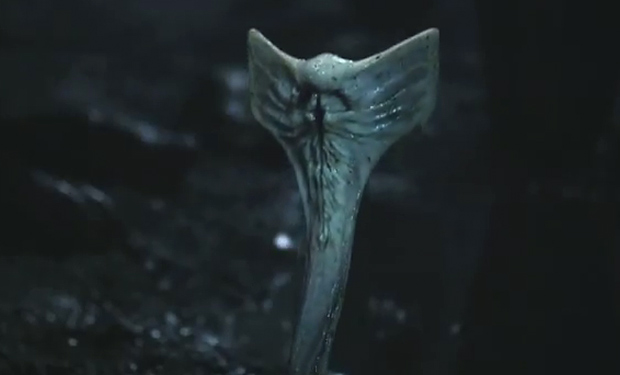
It's not all gods and robots though - in fact, we might understand this male creative impulse as a direct response to the mystery of the female body's innate creative power which, with aliens that look like this and this, comes across as a powerful and terrifying threat to male authority. Men seem to both be repelled by, and long for, the ability to do what almost any woman can do without even trying particularly hard, but as in Frankenstein, this usurpation of biological creation lands everyone in serious danger. Where in Alien we witness a literal male pregnancy, Prometheus is more concerned with other, less invasive methods of bypassing women in the creation of new life. That said, this film does still feature a horrific alien pregnancy, but this time it's a barren woman who is the victim, and this time, she survives, using a surgical machine to cut the hostile foetus out of her body before it can burst through itself. Here's where a comparison with Breaking Dawn becomes interesting. While Bella Swan/Cullen insists on suffering the monster child to tear its way out of her womb, loving the freaky blood-sucking monster that emerges and being "saved" from apparently inevitable death by being herself transformed into a blood-sucking monster by her blood-sucking monster husband, Dr Elizabeth Shaw (interesting sf trivia: this is also the name of a UNIT member in Doctor Who) does the sensible thing and gets the hell out. Like Ripley in Alien and Aliens, Shaw is resourceful, and she survives. Ripley, Shaw, and Meredith Vickers (Weyland's daughter, in charge of the mission in Prometheus) share a distrust of aliens, androids, and the greedy determination of the men around them, relying on their own wits and instincts to get by. In contrast to to the male-headed organisations that gladly put people at risk for financial or scientific gain, Vickers is willing to die for the sake of saving humanity, just as Ripley puts her own life on the line to rescue Newt in Aliens.

In general, Prometheus is not quite as tight or tense as either Alien or Aliens. Partly it suffers from a second-rate script, which never seems quite clever enough for the big ideas it seeks to convey, and scripting stands out as more of a problem in this film than in the earlier ones because the story requires that little bit more exposition. Apart from some fairly clunky and pedestrian dialogue, however, this is definitely a film worth seeing.
Finally, a couple of other significant characters deserve a mention here.
The first is Gwen Stacy in The Amazing Spider-Man. Despite the ridiculous way she dresses for lab work, Gwen is probably the most interesting female character in any of the numerous superhero films I've seen since the release of Spider-Man back in 2002. What's great about Gwen is that she is actually shown to have her own life and ambitions which are independent of her involvement with Peter Parker/Spider-Man. Gwen is not just Peter's equal - she's easily smarter than he is. Gwen is top of the class at school, and has managed to land herself a proper job at the most exciting and innovative scientific organisation in the city. Peter, meanwhile, sneaks onto a guided tour that she leads around the Oscorp building, and makes friends with Dr Curt Connors by passing off his father's formula as his own. Unlike Mary Jane, Gwen has Peter pretty well sussed from the start, and immediately guesses the reason that he starts pushing her away at the end of the film, but she doesn't insist that he comes back to her - if he doesn't want to see her, then she doesn't want anything to do with him either. Not only this, but The Amazing Spider-Man also presents us with a much more knowing, kind and intelligent version of Aunt May than do Spider-Man or either of its sequels. While we're still a far cry from equal rights and recognition for women in the super-hero world (take a look at Black Widow in this year's Avengers Assemble for a classic example of a token sexy super-heroine), The Amazing Spider-Man at least makes a damn good effort.
The second is Tiffany Maxwell in Silver Linings Playbook. What this film lacks in a good title, it more than makes up for in content. It's a genuinely touching and entertaining little gem, sad and funny and beautiful, and nothing like as cynical and Oscar-grabbing as you might expect a film about living with mental illness to be. Bradley Cooper is brilliantly compelling as Pat Solitano, recently diagnosed with bipolar disorder after a violent incident involving his wife and her lover. Robert De Niro and Jacki Weaver are also completely convincing as Pat's dysfunctional father and long-suffering mother. But, as ever, Jennifer Lawrence utterly steals the show as the woman who turns Pat's life around, teaching him to love himself and aiding him in his search for a silver lining. Lawrence's spellbinding performance makes us laugh and cry by turns. This is an actress fast proving the depth and range of her abilities, and I for one can't wait to see where she goes next.
So a good year for film, a good year for women. Stay tuned for another 2012 review, where I'll discuss the the complex political aspects of some of this year's best movies.
Monday, 30 May 2011
Le casa de Tomás
One thing you have to give Spanish/Hispanic film-makers is that they aren't half bad at horror.
El Orfanato, as well as El Laberinto del Fauno, Los Otros or El Espinazo del Diablo fits nicely into the national/horror cinema thesis that is pretty much compulsory learning for film students today. I forget names and stuff, but the general idea is that whilst Hollywood horror tends to address 'adult' concerns and sexual phobias (think vampires, wolves in the woods, and even man-made monsters, the single-parent creations that circumvent sex and maternity), Spanish and Hispanic horror lean more towards children's perspectives. Not that these are films you would dream of showing to a child, but the consciousness of that is precisely what makes them so utterly disturbing. The children in these films see far, far too much, and whilst we're offered spiritual and fantastic explanations for what's going on, we're made very aware of the childshness of these escapisms, especially when they're usually placed alongside an a plausible, rational explanation of what's going on. In The Orphanage, when Laura eventually discovers the corpse of her missing son Símon, we are shown a series of flashbacks explaining how he died after becoming trapped in 'le casa de Tomás'. No ghosts necessary.
The 'national cinema' element comes in, then, when we enquire into the origins of these phobias, and the subconscious levels on which they operate. Western society is, of course, founded quite unashamedly on sexual inequality. For centuries, we've lived in a world where women have plenty of good reasons to be afraid - hence the vampires and big bad wolves, cautionary tales for young virgins to guard against the threat of strange men. Of course, recognition of this oppression brings about a fear of rebellion and subversion, a terror of female sexuality on men's part, which leads to your mermaids, sirens and temptresses, as well as attempts to ignore the female altogether, and build new races of Frankensteinian 'men' where 'she' isn't necessary. Film in the States draws from our oldest myths and fairy tales, recreating the pre-Grimm 'children of the night' - 'children' we don't tend to think of as such any more.
Film hit Spain, however, in very different times. From the very beginnings of narrative cinema, the USA's past and its British heritage were available to delve into for source material, both countries being, at least in theory, open and democratic. The years that saw Hollywood's golden age in America, however, were lived rather differently across the water. Franco's dictatorship, and all the censorship that it entailed, lasted from the 30s right up until 1975. Film-makers then and there would have been either brave or stupid to attempt to produce anything more than propaganda for the regime. After its downfall, the gates were opened, and the buried past uncovered, just like the bodies that Laura discovers in the sacks in her shed, or the photographs that Grace Stewart finds in her attic. Where Hollywood horror had looked to Germanic fairy tales and 19th-century British writing for its inspiration, Latin American directors like del Toro made films about the myths perpetuated by Francoism, and the real-life suffering they concealed. The government's failure to fulfill its paternal responsibilities surfaces in neglectful or abusive parent-figures, and the deaths and suffering of children recalls the slaughter of hundreds of innocents during and after the Civil War. Or so the theory goes.
What is interesting is that wicked parents and step-parents are far from being an unfamiliar trope in almost any mythology. Snow White, Cinderella, and countless other stories that Disney didn't get their hands on bear a striking resemblance to noughties Hispanic horror. I've recently been reading up on my Grimm Bros, and have made some of my own discoveries about a pretty horrible past. Snow White, according to my copy of the collected tales, is just seven when her mother orders her execution. It's not long after this that she's taking care of a household on her own, and subsequently being whisked away to be married to a stranger. Read into properly, fairy tales begin to sound increasingly less far removed from things like this, which makes you wonder if, rather than the past, it's the present we really ought to be ashamed of. If we keep telling ourselves essentially the same stories, is it because we're trying to learn from them, to stop history repeating itself? Or is it simply because we never do learn, and because they're always still a too-often-ignored reflection of the world around us? Are we supposed to take hope from the fact that the past is being brought to light, and to believe that this knowledge can help us build something positive? Or should we despair that, even though so much has been revealed, the story still isn't over?
To put it another way, are the endings of films like The Orphanage and Pan's Labyrinth happy ever afters, or are they desperately tragic? The directors certainly don't seem to know where they stand on this, and I'm really not sure that any of the rest of us do, either.
Subscribe to:
Posts (Atom)